
Every student enquiry matters.
For a coaching institute, an enquiry is more than a phone number. It represents a student exploring an educational opportunity and a family considering an important decision.
But what happens after the enquiry arrives? Someone may need to call the parent, explain the course, answer questions, arrange an institute visit, schedule a demo class and follow up at the right time. When these activities are managed through scattered notes, calls and spreadsheets, it can become difficult to maintain a clear picture of every prospective admission.
A structured student enquiry management system for coaching institutes can help bring these activities together. The objective is not to automate every conversation. It is to help the team organize information, identify the next action and follow up more consistently.
Why student enquiry management can become difficult
Consider a coaching institute that receives enquiries through school seminars, telephone calls, referrals, WhatsApp messages and walk-in visits. Each enquiry may require a different response.
- One parent wants detailed information about a NEET preparation course.
- Another asks about fees, faculty or class schedules.
- A student is interested but needs to discuss the decision with their parents.
- A family wants to visit the institute before deciding.
- Someone who requested a callback may be unavailable during the first attempt.
Without a consistent process, staff may find it difficult to answer basic management questions: How many enquiries have arrived? Which parents need a follow-up? Who owns the next call? Which families have planned a visit? Which enquiries have progressed to a demo class or admission?
The challenge is not necessarily a lack of effort. It may be a lack of visibility and a clearly defined follow-up process.
How a structured enquiry management workflow works
1. Capture the enquiry
Record essential information in one place, such as a structured Google Sheet or an existing admissions system. Useful fields include the student’s name, parent’s name, contact number, class, course or examination, enquiry source and a summary of the conversation.
Consistent records make it easier for the team to find information and avoid repeatedly asking families for details they have already provided.
2. Understand the student’s requirements
The next step is to understand why the student or parent contacted the institute. An enquiry might concern Class 11 NEET preparation, Class 12 board examinations, a competitive examination course or a request for a demo class.
An AI-assisted workflow can help organize information supplied by the caller or staff member into consistent fields. AI should not invent missing details. Course fees, faculty information, schedules, admission conditions and other official information should come from approved institute records or staff.
3. Record interest and the current stage
Not every enquiry is ready for an admission decision. A simple tracking system can distinguish between stages such as New Lead, Interested, Follow-up Required, Visit Planned, Visit Done, Demo Class, Admission and Not Interested.
These stages help staff understand where each enquiry stands. The institute should define the stages clearly so that different team members use them consistently.
4. Identify the next action
Each active enquiry should have a clear next step. For example, a parent requesting course information may need approved course details; a family wanting to visit may need a suitable time coordinated; a student requesting a demo class may need availability checked; and a parent requesting a later callback may need that time recorded.
The next action should be specific enough for the assigned staff member to know what to do.
5. Assign responsibility and follow-up dates
A follow-up process becomes more manageable when every active enquiry has an owner and, where appropriate, a follow-up date. This helps reduce ambiguity about who should make the next contact.
The team can review outstanding follow-ups regularly and update the record after each interaction. The process should respect parents’ preferred contact times and avoid unnecessary or repeated calls.
6. Review progress through a dashboard
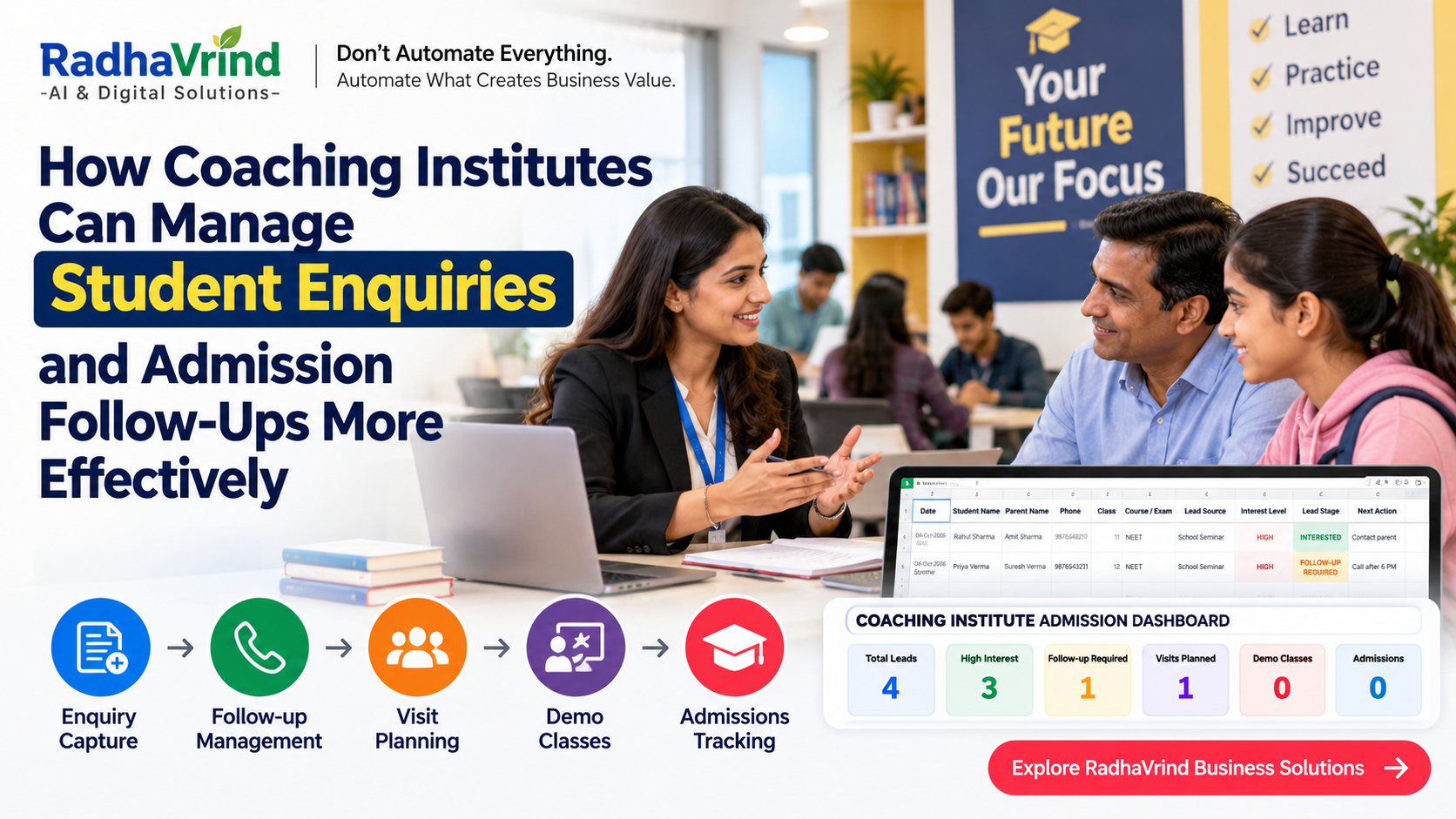
A dashboard can turn individual records into a useful management overview. A coaching institute might track total enquiries recorded, enquiries marked as interested, follow-ups requiring attention, planned institute visits, demo classes arranged and admissions recorded.
These figures help management understand the current workload and the stages that may require attention. A dashboard is only as reliable as the information entered into it, so staff should update records consistently and distinguish recorded activity from actual admission outcomes.
What can AI add to this process?
Traditional spreadsheets can store information and support basic tracking. AI can add value when staff spend time reading unstructured enquiry notes and converting them into consistent records.
Depending on how it is configured, an AI-assisted workflow may help extract student and parent details from submitted enquiry information, organize course requirements and summaries, classify enquiries using predefined stages, suggest a next action based on supplied information, update designated fields in a tracking sheet and present organized information for a dashboard.
AI should support the admissions team, not replace its judgement. Staff must verify important details, handle sensitive conversations personally and approve decisions concerning fees, eligibility, admissions and commitments made to families.
A practical demonstration: Coaching Institute Admission Dashboard
To explore this idea, RadhaVrind has developed a demonstration workflow for organizing coaching institute enquiries. The prototype combines an enquiry form, AI-assisted information processing, a Google Sheet for structured lead records and a dashboard for reviewing progress.
Its demonstration dashboard includes measures such as total leads, high-interest enquiries, follow-ups required, planned visits, demo classes and admissions. The accompanying lead sheet provides fields for contact details, course requirements, enquiry summaries, interest levels, lead stages, next actions, assigned staff and follow-up dates.
The aim is straightforward: make it easier to see what has happened, what needs attention and who is responsible for the next step.
Watch the Coaching Institute Enquiry Management Demo
See how a demonstration workflow organises student enquiries, structures lead information, tracks follow-up actions and presents progress through a management dashboard.
Demo notice: This is a prototype demonstration using sample data. The figures shown are illustrative and are not results from a live coaching institute. Actual implementation would be adapted to the institute’s processes and requirements.
Explore the RadhaVrind Business Solutions page to learn more.
Important: The figures shown in the demonstration are sample data used to illustrate the workflow. They are not results from a live coaching institute and should not be interpreted as evidence of increased admissions or revenue.
A real deployment would need to be adapted to the institute’s existing process, staff responsibilities, data requirements and approved communication methods.
How to introduce a system without disrupting your team
A coaching institute does not necessarily need to replace its entire admissions process to improve enquiry management. A sensible starting approach is:
- Map the current process. Understand how enquiries arrive, who contacts families, how visits and demo classes are arranged, and how admission outcomes are recorded.
- Identify the main problem. Determine whether the greatest difficulty is missing information, delayed callbacks, unclear responsibility, inconsistent records or limited management visibility.
- Start with a small pilot. Test a structured workflow with a limited set of enquiries. Use sample data during demonstrations and protect real student information during any live trial.
- Review practical outcomes. Check whether records are more complete, follow-ups are easier to identify and staff can see the status of each enquiry more clearly.
- Refine before expanding. Adjust fields, stages, responsibilities and notifications based on feedback from the people who handle enquiries.
Before using AI or connecting external tools to live records, the institute should also review access permissions, data retention, consent and applicable privacy requirements.
The business value: better visibility and more consistent follow-up
A well-designed enquiry workflow is not a guarantee of more admissions. Admission decisions depend on many factors, including course suitability, teaching quality, fees, parent preferences, competition and the student’s needs.
What a structured process can provide is greater visibility into the work that happens between the first enquiry and the final decision. Management can see which enquiries need attention. Staff can find relevant information more easily. Follow-up responsibilities become clearer, and the institute can review its process using recorded information rather than relying entirely on memory.
These are useful starting points for improving the way an admissions team works.
Explore AI and digital solutions with RadhaVrind
RadhaVrind helps businesses explore practical AI and digital solutions around real operational problems. The approach is problem-first: understand the existing process, identify where time or opportunities may be lost, build a suitable solution and evaluate its usefulness before expanding it.
For coaching institutes, this may begin with enquiry organization and follow-up tracking. Other businesses may need help with buyer enquiries, repetitive administrative tasks, customer communication or workflow visibility.
Don’t Automate Everything. Automate What Creates Business Value.
Explore the RadhaVrind Business Solutions page: https://comparebeforeyoubuy.in/business-solutions
To discuss a business workflow, contact RadhaVrind at desirachh@gmail.com or WhatsApp +91 7009708305.
Want this type of content for your business? Contact Rajesh Kumar | Mobile No. 7009708305
Tags: student enquiry management system for coaching institutes, coaching institute admission management, student lead follow-up, admission enquiry tracking, AI workflow for coaching institutes
Originally published on Compare Before You Buy — India's trusted price comparison platform for Amazon, Flipkart, Myntra & more.